What is considered heavy for a dumbbell? It’s the weight you cannot lift for your planned repetitions with steady control and good form. Don’t judge by the label alone: the same load may suit one exercise and be too heavy for another. Your current strength and target repetitions matter too
From single-versus-pair labels to testing a starting weight and knowing when to progress, this guide helps you choose a load that fits each exercise while keeping your technique controlled.
Why the same dumbbell feels heavy for one exercise and light for another
Different exercises place different demands on the body, so one pair won’t suit every movement. Exercise setup, how you hold the weight, planned repetitions, familiarity with the movement, and current fatigue all affect the task.
Curling a dumbbell, pressing it overhead, rowing it from a supported position, and holding it during a squat are separate tests. Do not transfer a successful weight from one exercise to another without checking that movement. Simply picking a dumbbell up also does not establish that you can complete a controlled set with it.
Beginner, intermediate, and advanced are not compulsory kilogram bands. An experienced lifter may still choose a lighter dumbbell for a particular movement, while a beginner needs to establish control rather than meet a status label. ACSM’s resistance-training guidance emphasises tailoring load and training volume to the goal instead of applying one prescription to everyone.
Check the label: per dumbbell, per hand or per pair?
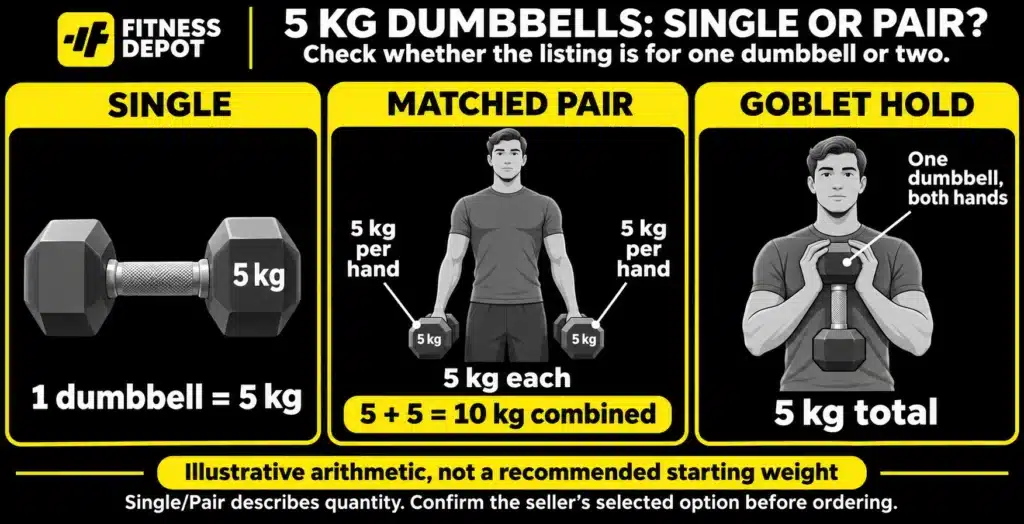
Always establish what the weight label describes before comparing equipment or recording a workout. One dumbbell’s mass, the weight in each hand, and the combined weight of a pair are different quantities.
For example, two 5 kg dumbbells weigh 10 kg combined, but each hand holds 5 kg. A goblet exercise using one 5 kg dumbbell uses 5 kg total, even when both hands hold it. These examples explain notation; they are not recommended starting weights.
A clear record would say “5 kg per hand, two dumbbells,” rather than simply “10 kg.” For a one-dumbbell movement, record one item and its weight. An adjustable set’s advertised total may include several components, so confirm what one assembled handle weighs at the selected setting.
Fitness Depot’s rubber-coated dumbbell listing offers Single and Pair quantity options alongside several weight choices. Check both selections before ordering; the selected weight and quantity determine what you receive.
How to choose a starting dumbbell weight
Use a light, controllable trial for the actual exercise, then assess the planned repetitions. Start with a load you can handle steadily; later repetitions should feel challenging without requiring you to test your maximum. You do not need to discover your maximum before choosing a useful starting load.
- Choose the exercise and repetition target. Know which variation you are practising and whether the load is one dumbbell or one in each hand.
- Rehearse the movement, then try a manageable load. Begin with control rather than a predetermined kilogram label.
- Assess the whole set. Check whether you can repeat the intended movement steadily without unwanted momentum or losing the position you are trying to maintain.
- Adjust only after reassessing. Reduce a load that prevents control; if the task is clearly too easy, consider a slightly higher available option after appropriate rest and check again.
As one general starting reference, Mayo Clinic suggests a weight you can lift comfortably for roughly 12–15 repetitions. This is not the only valid repetition range, nor a rule that a lower-repetition strength set is automatically too heavy. The target should match the exercise and purpose.
That is why “Are 4 kg dumbbells good for beginners?” and “Should I start with 5 kg or 10 kg?” cannot be answered by the number alone. Try the movement with a controllable option; do not automatically double the weight because a lighter example appears in a guide.
A challenging set does not require deliberately failing a repetition. ACSM’s resistance-training guidance reports that training to momentary failure did not consistently affect outcomes for the average healthy adult. Use that distinction to avoid treating loss of control as the test of a worthwhile session.
Choosing weight by common exercise
Choose the load separately for each exercise and record its quantity clearly. These are selection checks for movements you have learned, not a complete technique tutorial or a beginner-to-advanced kilogram chart.
|
Exercise/movement |
Loading notation |
What to check when trying a load |
|
Biceps curl: hammer-curl example |
One dumbbell per hand; record each |
Can you lift and lower without swinging or changing the planned torso position? |
|
Dumbbell shoulder press |
One dumbbell in each hand |
Can you establish the starting position and press/lower with control? |
|
Supported single-arm row |
One dumbbell in the working hand |
Can you maintain the supported setup while controlling the lift and lowering on each side? |
|
Goblet squat |
One dumbbell held in both hands; record total |
Can you hold it at the chest and control the squat movement you have learned? |
|
Dumbbell hip hinge: RDL example |
One dumbbell in each hand |
Have you learned the unloaded hinge, and can you retain that pattern with this load? |
The takeaway is to repeat the selection check when the movement or setup changes. A weight that works for a supported row does not establish your pressing load, and holding one dumbbell in two hands is not the same notation as holding one in each hand.
For movement ideas beyond this selection guide, see Fitness Depot’s dumbbell exercise guide. Choose exercises appropriate to your ability and get coaching where the movement is unfamiliar; you do not need to perform every listed exercise with one pair.
When to keep, increase or reduce the weight
Base the decision on repeatable work for the same exercise and repetition target. When it becomes consistently manageable, a small available increase may be appropriate; reassess control after the change rather than treating a heavier label as success by itself.
- Keep the weight when the planned work remains appropriately challenging and controlled. There is no requirement to change the dumbbell every session.
- Consider increasing when the same task is consistently manageable. Use an available increment you can assess without forcing a large jump.
- Reduce or reassess when the planned movement cannot be maintained. Review the load, repetitions, and task rather than trying to complete it at any cost.
Keep a simple record: exercise and variation, load per hand or total for one dumbbell, repetitions, and perceived difficulty. Note a changed setup so you do not compare unlike tasks. This gives you a clearer basis for decisions than comparing your dumbbell label with another person’s.
No fixed weekly kilogram increase is required here. If the next equipment setting is too large a step, discuss options with a qualified trainer instead of forcing it. Progress can include completing planned work more consistently; it need not mean buying a heavier pair immediately.
Signs the weight is too much for the task
Effort and inability to execute the intended movement are different. Unwanted swinging, losing the planned position, or being unable to set up and put down the dumbbell under control are reasons to stop and reassess that task.
If you cannot maintain form, reduce the load or repetitions; stop if an exercise causes pain. Pain is not proof of progress. Ask a qualified trainer for help with uncertain technique or loading, and seek appropriate clinical guidance for injury or persistent symptoms.
Apply the handling check to the whole exercise, including picking up and replacing the weight. Completing a repetition does not resolve an uncontrolled setup. Equally, a technique check is not a guarantee against every problem; use professional help when you cannot establish what is going wrong.
Fixed, hex, round or adjustable: what should you buy?
Fixed and adjustable describe how the load is provided; hex and round describe head shape. A dumbbell can be both fixed-weight and hex-shaped, for example. Choose around the exercises, manageable settings, and storage you need.
Fixed dumbbells provide a ready load without changing a mechanism. Adjustable designs provide multiple settings, but their convenience depends on the particular system. Compare the minimum and maximum usable weight and the smallest increment, not just the largest figure on the box.
Before purchasing, check the grip and handle size, locking instructions, included components, single/pair quantity, storage, and permitted use. For an adjustable set, establish whether the quoted mass includes handles, plates, and collars. Do not infer dropping permission or suitability as a floor-supported exercise handle from head shape alone.
To compare mechanisms, increments, and storage for adjustable options, see the adjustable dumbbell buying guide. Focus on settings that suit your exercise list rather than choosing a set only for its maximum weight.
Dumbbell ke liye kitna weight heavy mana jata hai?
There is no single number, because heavy depends on your strength, experience and the exercise. A dumbbell is heavy for you when you can only do a few repetitions before your form starts to slip.
A weight that feels heavy for a shoulder press may feel light for a squat. Start with a weight you can control for every rep, and increase it gradually as the last reps feel easier.
Choose an appropriate challenge for each exercise
A useful dumbbell weight is specific to the movement, repetition target, and controlled execution. Compare Fitness Depot’s dumbbell weights and types for a practical range and usable increments, then confirm whether your chosen item is a single or a pair. Select equipment that supports sensible adjustments rather than treating heavier ownership as proof of progress.
Frequently Asked Questions
Is a 12 kg dumbbell considered heavy?
For one dumbbell, 12 kg may be challenging for one movement and manageable for another. Judge it against the intended repetitions, your current ability, and control throughout the task. The number alone has no universal heavy/not-heavy label.
Can 5 kg, 10 kg or 15 kg dumbbells build muscle?
A given load may provide useful resistance for a particular person and exercise, but no fixed kilogram label guarantees muscle growth. The wider programme and how its challenge develops matter. A weight need not remain sufficient for every exercise indefinitely, and progress does not require reaching failure on every set.
Can I lose belly fat using dumbbells?
Dumbbells can support a broader fat-loss plan and help build or maintain strength, but they cannot guarantee belly fat loss specifically. The CDC explains that physical activity combined with reducing calorie intake creates a calorie deficit that supports weight loss. Pair resistance training with sustainable eating habits and other activity.
What kills muscle gains the most?
No single issue stops progress for everyone. Missing sessions, too little recovery, nutrition that does not support training, or a plan that stops challenging you can each make muscle gains harder. Keep resistance training consistent, allow time to recover, and adjust the work as your ability improves.