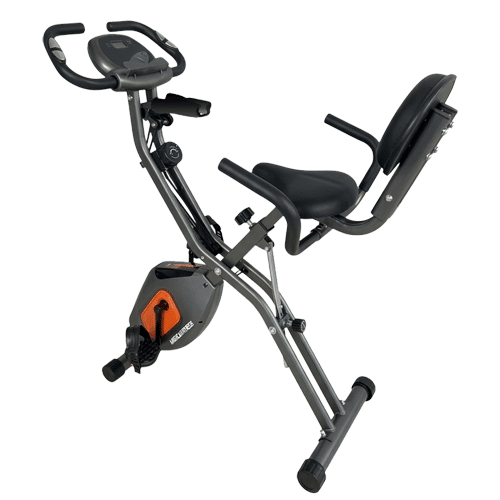
Fitness Depot featured image showing upright and recumbent exercise bikes side by side for a home cardio buying guide comparison.

Upright Bike vs Recumbent Bike: Which Exercise Bike Is Right for You?

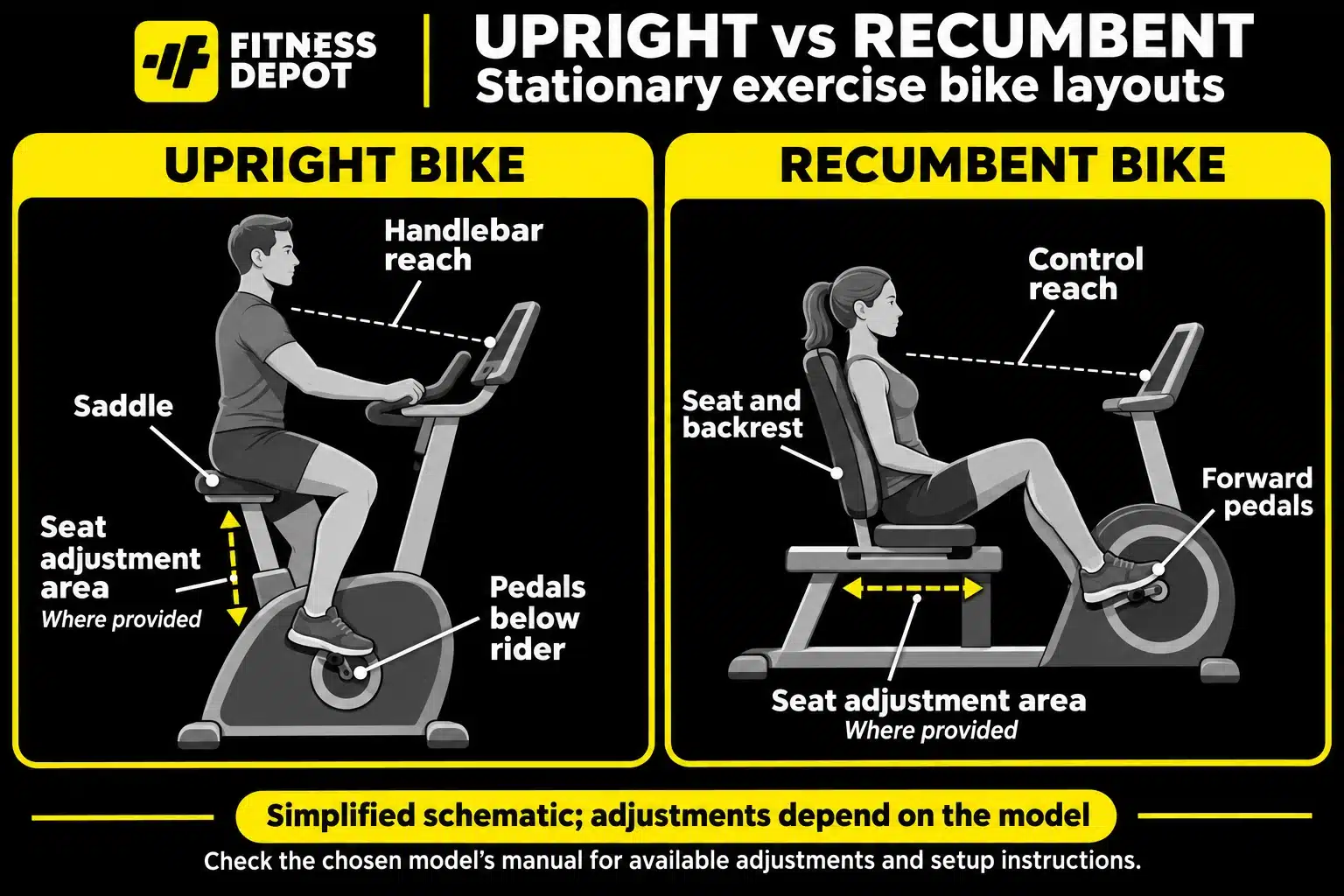
An upright exercise bike uses a saddle-style seat with pedals below the rider, while a recumbent bike places the pedals farther forward and provides a seat with a backrest. The better choice depends on your preferred riding position, support, access, and fit, alongside the exact bike’s space and features. Both can support cardio activity; posture alone does not establish workout intensity or medical suitability.

For a home buyer in Pakistan, compare the person and the room before comparing promotional labels. A bike needs to fit the intended riders, be practical to get on and off, and have operating requirements you can accommodate.

Upright bike vs recumbent bike at a glance

The clearest difference is how you sit relative to the pedals and back support. Use these design distinctions to narrow your options, then check the individual model rather than assuming every bike in a category is identical.

Comparison point

Upright bike

Recumbent bike

Seat and posture

Saddle-style seating

Seat with backrest; more reclined position

Pedal location

Below the rider

Farther forward

Back support

Conventional saddle layout without a backrest

Backrest provided; position and fit vary

Getting on and off

Check frame, saddle height and permitted supports

Check frame opening, seat height and transfer route

Adjustment and comfort

Saddle position, pedal and handlebar reach

Seat travel, depth, backrest and pedal reach

Workout controls

Resistance and programmes depend on model

Resistance and programmes depend on model

Footprint and operating space

Measure assembled size and required clearances

Measure assembled size, seat travel and clearances

Best-fit preference

Saddle-style riding that fits the user

Back-supported riding that fits the user

The practical takeaway: shortlist by the riding position you prefer, then verify fit and entry/exit. A backrest, compact-looking frame, or extensive programme list is not enough to settle the purchase.

Design and riding position: what actually changes?

Both machines are stationary indoor exercise bikes: you pedal in place rather than travel along a road. Their seating and pedal layouts create different riding experiences, so outdoor-bike issues such as traffic visibility and commuting do not answer this comparison.

On a conventional upright, the rider sits on a saddle and reaches towards handlebars, with the pedals below the body. On a recumbent, a seat and backrest support a more reclined position, with the pedals farther forward. Check the reach between seat, pedals, and controls rather than choosing from a photograph alone.

Adjustment matters in both layouts. Spirit lists up/down and fore/aft saddle adjustment for its CU800; fore/aft means forwards and backwards. Its CR800 documentation describes a step-through frame, seat and back pad, and fore/aft seat adjustment. These are named manufacturer examples, not proof that every locally listed version has identical features. For local product details, see the Fitness Depot listings for the Spirit Fitness CU800 upright bike and the Spirit CR-800+ recumbent bike.

A conventional upright exercise bike is also distinct from a dedicated indoor cycling or spin model. Do not assume that standing sprints or a particular riding position is permitted because both machines have pedals and a saddle. Check the exact model’s intended use and operating instructions.

Black and yellow infographic compares upright and recumbent exercise bikes, showing rider positions, seat adjustment, handlebar reach and pedal locations.

Comfort and accessibility: check the person and the bike

Neither upright nor recumbent bikes are universally more comfortable. Seat shape, adjustment, pedal reach, handlebar or control reach, and the individual determine whether the arrangement works. A smaller saddle does not prove discomfort, and a backrest does not guarantee pain relief.

For an upright, check whether the available saddle positions let the intended rider reach the pedals and handlebars without awkward stretching. For a recumbent, assess seat depth, backrest position or angle, and fore/aft adjustment. Establish which features actually adjust; do not assume the backrest changes angle because the seat slides.

Getting on and off deserves its own check. Where provided, a step-through opening is a passage through the frame, but its dimensions and the user’s ability still matter. A lower seat can create a transfer difficulty for some people even when stepping over the frame looks straightforward.

Before choosing, follow the model manual and work through a practical fit check. An appropriate supervised trial, if available, can help answer questions that dimensions alone leave open:

  • Can the intended user approach, get on, and get off using the permitted supports and method?
  • Can they operate the seat adjustment, reach the pedals and controls, and secure their feet as instructed?
  • Can they pedal smoothly without awkward reaching, and can every intended household user find a workable adjustment?

If pain, injury, recovery, balance, or transfer limitations affect use, seek individual professional guidance instead of choosing solely by category. Mayo Clinic’s arthritis guidance likewise recommends selecting activity with a healthcare professional and avoiding painful exercise. Neither a supported seat nor saddle seating is an automatic medical recommendation.


Workout feel, effort and weight-management goals

A backrest does not make a workout automatically easy, and an upright posture does not guarantee higher calorie use. Resistance, cadence, duration, effort, and the model’s capabilities shape the session. Resistance is how much the bike opposes pedalling; cadence is the rate of pedal revolutions.

Cleveland Clinic identifies cycling as low-impact cardio and distinguishes low impact from low effort. Spirit’s CR800 also documents resistance and programme options, illustrating that supported seating can coexist with adjustable exercise demand. This does not establish identical workout responses across different bikes.

Compare controls by what they let you do, not simply by counting resistance levels. The same displayed level on two different machines does not establish equal demand. Check whether the settings are understandable, reachable from the seat, and suitable for the activity you intend.

Are upright bikes good for weight loss? They can contribute to physical activity and energy expenditure, as recumbent bikes can, but neither guarantees weight loss. CDC’s weight-management guidance explains that activity and food intake both affect energy balance and that individual activity needs vary. Seating position alone does not establish a calorie advantage.

Both involve leg pedalling, but that is not evidence of superior toning, guaranteed muscle growth, or equal long-term results. Choose a workable activity and appropriate effort rather than relying on an unsupported calorie ranking between the two designs.


Home-use differences: space, access and ownership

Compare actual assembled dimensions, seat travel, and the manual’s operating clearances. Recumbent layouts can extend farther forward, but the measurements of the specific models should decide room fit. A category label cannot establish which bike fits your home.

Measure the room and delivery route

Record dimensions in consistent metric units and mark the assembled footprint on the floor. Allow separately for seat movement, getting on and off, and the manufacturer’s required clearances. A bike that occupies a corner while unused may need more usable area when a person approaches or adjusts it.

Check doorways, turns, stairs or lifts, and access to the final position. Confirm whether delivery is assembled or packaged and what assembly is required. Stored size, operating size, and delivery size are different questions; do not infer that a bike folds or can be carried easily.

For shared use, check how adjustments work between riders and whether everyone can see and reach the console. A model that suits one person’s reach may not accommodate another. Keep the actual users and required adjustment range in the shortlist rather than relying on broad beginner or age labels.

Confirm power, noise and upkeep

Ask what power source the exact bike requires and follow its manual for setup. Some features may have their own requirements, so do not assume every stationary bike needs mains power or that pedalling alone powers every console. There is no verified electricity-cost comparison here.

Ask for operating information or an appropriate demonstration if sound matters in your household. Compare the actual model and condition rather than assuming all recumbents are quieter or all uprights transmit the same vibration. No measured household noise figures are established by this guide.

Check the manual’s cleaning, inspection, and maintenance instructions, along with applicable parts and service arrangements. Confirm the seller’s current terms for the exact model and intended setting. A commercial label does not itself establish a home warranty, installation service, or suitability for every household.

Which exercise bike should you shortlist?

Choose a category around riding preference, then compare models against fit, access, and ownership needs. Neither bike type should be assigned automatically to all beginners, older adults, or people with a particular condition. If you are also comparing ellipticals, see Fitness Depot’s broader home cardio comparison.

  • Prefer saddle-style seating? Explore upright exercise bikes in Pakistan, then confirm that the exact bike fits the rider and available operating space.
  • Prefer a back-supported seat? Explore recumbent exercise bikes, checking entry/exit, seat adjustment, and pedal reach for the intended user.
  • Space, shared use, or mounting is decisive? Compare individual frames and adjustment ranges before choosing a category; a general design advantage may not apply to your shortlisted model.

Before ordering, confirm the intended users and adjustment range; seat, handlebar and pedal fit; getting on and off; rated capacity and intended use; operating footprint and clearances; resistance and controls; power and manual requirements; maintenance/support; and current seller terms. Resolve missing or contradictory specifications before treating a model as suitable.

Upright Bike aur Recumbent Bike mein kya farq hai?

An upright bike has a seat like a regular bicycle, so you sit upright and lean slightly forward. It takes less floor space and engages your core more. A recumbent bike has a larger seat with a backrest, so you sit back and pedal in front of you, which supports your lower back and feels more comfortable.

Choose an upright bike if you want a compact, bicycle like workout. Choose a recumbent bike if you want back support or a gentler, longer session. If you have a back, knee or hip problem, check with a doctor before you start.

Choose a bike that fits the rider and room

Start with your preferred riding position, then verify access, adjustment, and the exact bike’s home footprint. Explore Fitness Depot’s upright bikes and recumbent bikes, and confirm the selected model’s specifications and operating requirements before buying. A clear fit assessment is more useful than assuming one design is best for everyone.

Frequently Asked Questions

How many minutes on a recumbent bike equals 10,000 steps?

There is no universal equivalence established here. Cycling time, pedal revolutions, console distance, and actual walking steps are different measurements, while effort and device counting vary. Record duration and effort for your activity goal rather than converting a bike session into a fabricated walking-step total.

Is stationary cycling equivalent to walking for the same amount of time?

Equal duration alone does not prove equal calories, fitness effects, or suitability; the purpose and actual effort matter. CDC’s general adult guidance uses at least 150 minutes of moderate or 75 minutes of vigorous aerobic activity weekly, or an equivalent mix, plus muscle-strengthening activity on at least two days. That US population guidance provides context, not an exact cycling-to-walking conversion or a personalised daily prescription.

What happens if I ride a stationary bike every day?

Daily rides can help you maintain a regular cardio routine, but cycling every day is not required. Keep the effort manageable and take an easier day or rest if you develop pain or unusual fatigue. For adults, use the CDC’s weekly activity guidance as a general target, then adjust the routine for your health and ability.

Why do my knees hurt after a recumbent bike?

Knee pain can have several causes, and the bike type alone cannot identify one. Check your bike’s manual for seat adjustment and pedal reach, keep resistance comfortable, and consider whether you recently increased your session length or effort. Stop if pedalling hurts; get medical advice if pain persists, worsens or follows an injury. NHS exercise-bike guidance also advises stopping when pain starts.


Leave a Reply

Your email address will not be published. Required fields are marked *

Related Projects