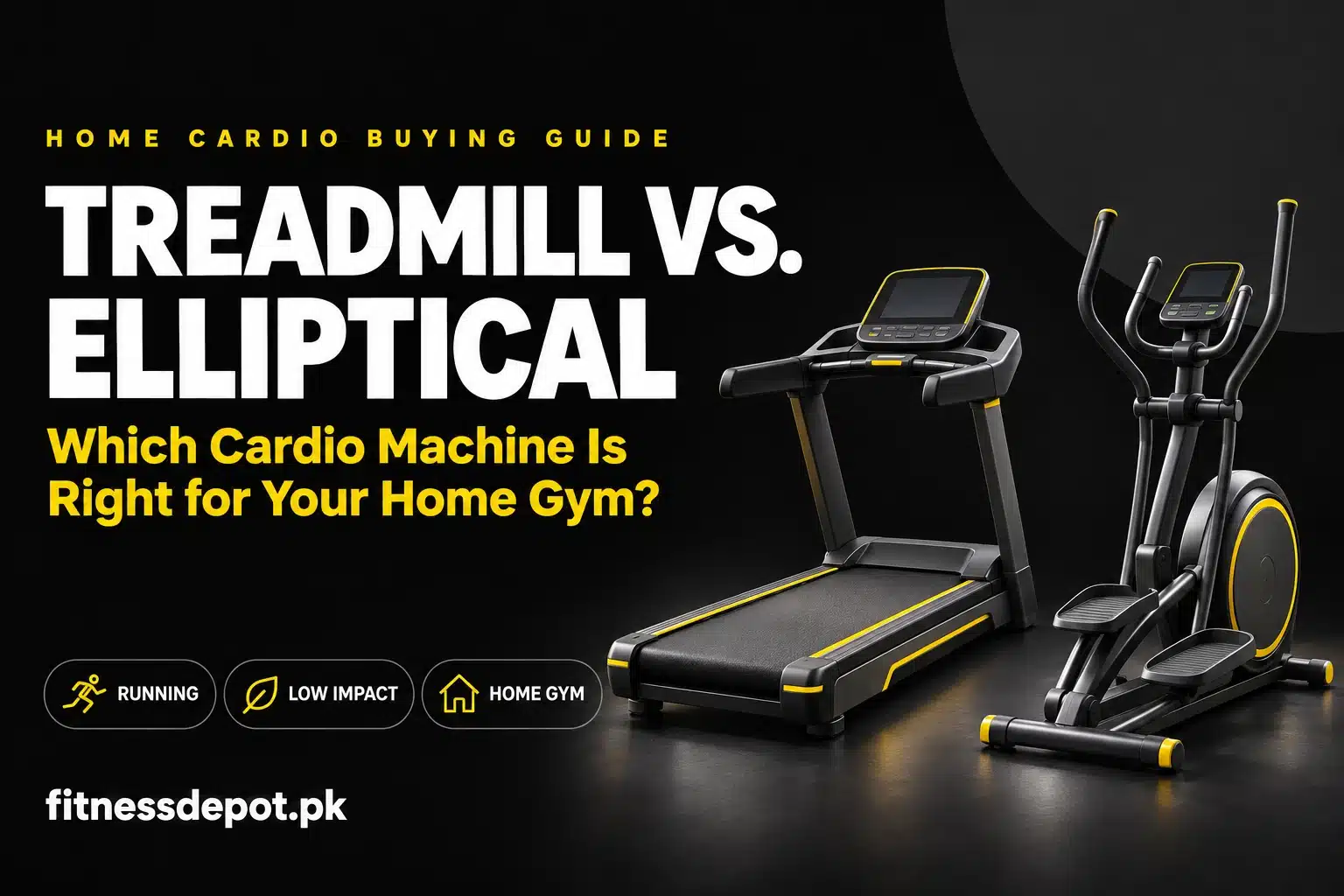
Treadmill vs Elliptical: Which Cardio Machine Is Right for Your Home Gym?
A treadmill suits actual walking or running, while an elliptical provides supported-pedal striding that may suit a preference for lower-impact cardio. Neither is best for everyone: choose around your movement preference, comfort, goals, and the exact model’s fit in your home. Treadmill walking differs from running, and an elliptical does not guarantee joint safety.
For a home buyer in Pakistan, the decision also includes where the machine will operate, how it will arrive, and how it will be maintained. Start with the activity you want to do, then check whether a specific machine and your room can support it.
Treadmill vs elliptical at a glance
The main distinction is a walking or running belt versus a guided pedal path. Features, storage arrangements, and ownership requirements vary by model, so use this comparison to build a shortlist rather than award one category an overall score.
|
Decision factor |
Treadmill |
Elliptical |
|
Movement |
Walking/running on a belt |
Supported-pedal striding |
|
Walking/running specificity |
Direct walking or running practice |
Different movement pattern |
|
Impact and comfort |
Walking differs from running; assess comfort |
Lower-impact option; fit and suitability still matter |
|
Intensity controls |
Speed; incline where fitted |
Resistance and cadence; other features vary |
|
Moving handles |
Not the usual movement pattern |
Arm involvement where fitted and actively used |
|
Room and height |
Operating footprint, clearances, user height and incline |
Operating footprint, clearances, pedal elevation and moving parts |
|
Storage |
Foldability and moving arrangements are model-specific |
Stored size and moving arrangements are model-specific |
|
Noise and maintenance |
Check drive, footfalls, vibration and manual |
Check moving parts, vibration and manual |
The table’s movement and comfort distinctions are consistent with Cleveland Clinic’s comparison. Space, features, noise, and servicing depend on the chosen model’s documentation and supplier. No calorie ranking, universal footprint, or medical suitability score is implied.
Walking, running or elliptical striding: which movement do you prefer?
Choose a treadmill shortlist if your aim is walking or running practice. Elliptical striding is a different activity: your feet remain on pedals following the machine’s path. Try that movement before buying rather than assuming it will feel like walking.
On a motorised treadmill, the belt moves at the selected speed. The running surface is the usable belt area beneath your feet; check its dimensions and the manufacturer’s intended use for your activity. This guide centres on motorised models rather than treating curved, non-motorised treadmills as interchangeable.
An elliptical’s stride length describes the distance of its pedal movement. Check whether that path feels comfortable for each intended user. Moving handles, where fitted and actively used, add arm involvement, but their presence alone does not establish a better workout.
Think about the routine you actually want. If walking is the activity you enjoy, replacing it with a machine you find awkward may not solve the problem. If supported striding feels preferable, there is no need to choose a treadmill simply because running is a familiar comparison point.
Workout intensity, comfort and weight-management goals
Neither the machine name nor a session’s duration tells you how demanding the workout is. Separate impact, effort, and the result you want before comparing two sessions.
Low impact does not mean low effort
Impact describes the loading associated with movement; intensity describes how hard you are working. Treadmill speed and incline, where available, and elliptical resistance and cadence can change the demand. Resistance is how much the machine opposes movement; cadence is your movement rate.
Is 30 minutes on an elliptical better than walking on a treadmill? Time alone cannot decide. Compare the purpose, actual effort, settings, and comfort. An easy elliptical session and a demanding treadmill walk are different comparisons from two sessions performed at similar perceived effort.
CDC’s intensity guidance offers a simple context: during moderate activity, you can generally talk but not sing. Use effort alongside duration when recording activity. Treat a console’s calorie number as an estimate rather than a guaranteed measurement or proof that the other machine would have produced less.
What calorie research can and cannot tell you
Research findings depend on who exercises and how the comparison is run. They should not become a promise about your next session or a fixed calorie chart for every machine.
Brown and colleagues’ June 2010 study tested 18 untrained college-aged participants in separate 15-minute treadmill and elliptical bouts at perceived exertion 12–13. Energy expenditure did not differ significantly under that protocol. The author-uploaded paper supports that specific finding, not equal calories at every setting.
A February 2024 study by Prieto-González and Yagin tested 30 recreationally active middle-aged men during 12-minute bouts at high perceived effort and maximal intensity. The treadmill produced higher estimated energy expenditure than the elliptical under those conditions. Different participants and protocols help explain why one result cannot establish a universal winner.
For equipment selection, this means avoiding a purchase based solely on an advertised calorie total. Consider the movement and level of effort you can use appropriately, together with the practical conditions that make the machine usable at home.
Which is better for losing belly fat?
Neither machine selectively removes belly fat. The University of Sydney’s explanation of spot reduction rejects the idea that exercising a particular area determines where fat is lost. Using an elliptical’s handles or choosing treadmill incline does not establish a targeted belly-fat result.
Either can contribute physical activity within a broader weight-management approach. CDC explains that activity and food intake both affect energy balance, and activity needs vary between people. Choose equipment as part of sustainable habits rather than expecting its purchase, a calorie display, or a particular session length to guarantee weight loss.
Comfort needs an individual check
An elliptical may appeal when supported-pedal movement feels preferable, especially compared with running. But treadmill walking remains a different option from running. Check stride fit, getting on and off, coordination, and your response to the activity; a lower-impact label does not determine suitability.
For pain, injury, postoperative recovery, or balance limitations, seek individual professional guidance before choosing by machine category. Mayo Clinic’s arthritis guidance similarly emphasises selecting activity with a healthcare professional and avoiding exercise that causes pain; it does not prescribe one machine for every painful joint.
Which machine fits your home? Space, storage, noise and maintenance
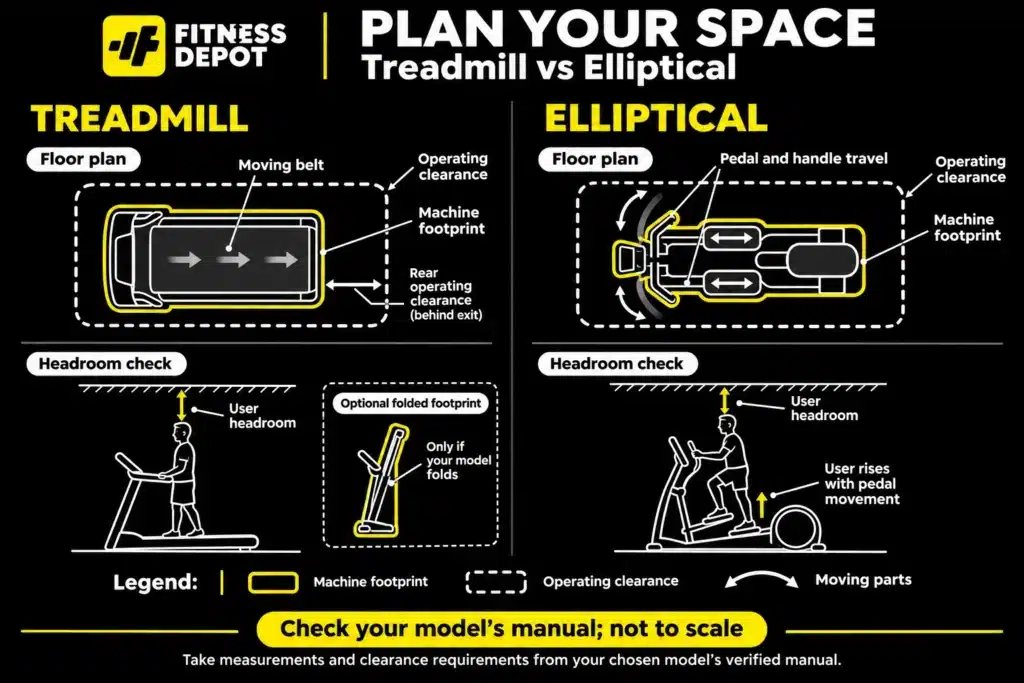
Compare the space each specific model needs while operating, not just the size shown in a shop photograph. A machine that fits when folded may still be impractical to use in the room.
Measure the operating area and headroom
Obtain assembled dimensions and the manufacturer’s required clearances. Mark the footprint on your floor in consistent metric units, then mark the separate operating area around it. Include room for access and mounting without assuming that a universal clearance distance suits every model.
Check headroom with the user at the highest relevant operating position. Account for pedal elevation, moving handles, and treadmill incline where applicable, together with ceiling features. Machine height alone is not the user’s required headroom, and an elliptical’s small-looking base does not prove it will fit vertically.
Work through the delivery route too: entrances, doorways, turns, stairs or lifts, and the path into the room. Ask the supplier about delivery form, assembly requirements, and the model’s actual dimensions before committing. Do not assume a machine that fits the room can pass through every approach to it.
Separate storage convenience from workout space
Verify whether the exact model folds, its stored dimensions, and the handling procedure in its manual. Folding and moving are separate questions. Ask how it would be relocated in your home, including thresholds and changes in floor level, rather than assuming transport wheels make every move straightforward.
For a shared room, consider the complete routine: setting up the machine, restoring its operating clearances, using it, and storing it again. If that process is impractical, a smaller stored footprint may offer little everyday benefit. Do not assume all treadmills fold or all ellipticals have the same storage arrangement.
Check power, sound and servicing
Confirm power and outlet requirements against the chosen model’s manual, including any requirements for placement and permitted electrical connections. Check powered consoles and drive systems individually. Neither category name establishes electricity use, and there is no verified rupee running-cost comparison in this guide.
Ask for model-specific operating information or a demonstration for the intended activity. Consider motor or drive sound, footfalls, moving components, vibration, and the condition of the machine and floor. A general claim that an elliptical is silent, or that a mat will prevent disturbance, is insufficient for a noise-sensitive household.
Follow the manual for cleaning, inspections, and belt/deck or drive servicing as applicable. Confirm what support, parts, and maintenance arrangements actually apply to the exact model. Do not assume one lubrication schedule, warranty entitlement, or lifetime ownership cost covers a whole category.
Keep a shortlist record with the model name, manual, measured room fit, and unresolved questions. This turns a broad treadmill-versus-elliptical debate into a comparison you can verify. For shared use, repeat the movement and fit checks for each intended user.
A simple decision guide before buying
Shortlist by movement first, then compare individual models against the users and room. These are practical buying decisions, not medical rankings:
- You want actual walking or running: explore Fitness Depot’s treadmill range and confirm that the selected model is intended for your activity and home setting.
- You prefer supported-pedal striding: explore Fitness Depot’s ellipticals, subject to a comfortable movement fit and the model’s operating requirements.
- Storage, shared use, or noise is decisive: compare exact models, manuals, and operating information rather than assuming one category wins.
- Symptoms or balance concerns affect use: obtain individual advice before treating either shortlist as suitable for you.
Before ordering, confirm user capacity and movement fit, dimensions and operating clearance, required controls and features, power instructions, maintenance and parts support, budget, and the seller’s written terms. Resolve missing or contradictory specifications rather than selecting whichever figure looks preferable.
For more model-selection detail, see the guides to choosing a treadmill in Pakistan and choosing a home elliptical. Keep the final choice tied to the exact model: a category listing or buying guide does not establish every product’s suitability.
Treadmill aur Elliptical mein kya farq hai?
A treadmill lets you walk, jog or run on a moving belt, so the movement feels like exercising outdoors. An elliptical lets your feet glide along a set path while you move the handles, which works your arms and legs together with less impact on your joints.
Choose a treadmill if you want to run or build running stamina. Choose an elliptical if you prefer a smoother, joint-friendly workout. If you have a knee, hip or back problem, check with a doctor before you start.
Choose the movement and model that fit your home
A useful comparison ends with a machine you can use comfortably for your intended activity and accommodate properly. Explore Fitness Depot’s treadmills and ellipticals, then confirm the selected model’s dimensions, capacity, power requirements, service arrangements, and suitability before buying.
Frequently asked questions
How long on an elliptical is equal to 10,000 steps?
There is no universal minute-to-step conversion established here. Elliptical strides, device step estimates, and actual walking steps are different measurements, and machine designs and cadence vary. Compare recorded duration and effort for your activity goal rather than treating a console count as an exact walking equivalent.
Does treadmill exercise build muscle?
Treadmill exercise uses muscles during aerobic movement, but muscle involvement alone doesn’t create a complete progressive strength programme or guarantee growth. General adult activity guidance includes separate muscle-strengthening work. Moving elliptical handles should not automatically be treated as a replacement either.
How much time should you spend on a treadmill or elliptical?
No single daily duration fits everyone; purpose, intensity, weekly activity, recovery, and health matter. CDC’s general adult guidance uses at least 150 minutes of moderate or 75 minutes of vigorous aerobic activity weekly, or an equivalent mix, plus muscle-strengthening activity on at least two days. This US population guidance is context, not a personalised prescription or a weight-loss guarantee.
Is 5 miles on the elliptical the same as 5 miles on a treadmill?
Not necessarily as a workout. Although both consoles can show miles, a treadmill tracks distance traveled on its walking or running surface, while an elliptical’s feedback is based on pedal rate; check the specific treadmill manual and elliptical manual. A matching distance display does not mean the sessions took the same time, required the same effort, or burned the same calories. Compare duration and effort, and use each machine’s distance reading to track progress on that model.